

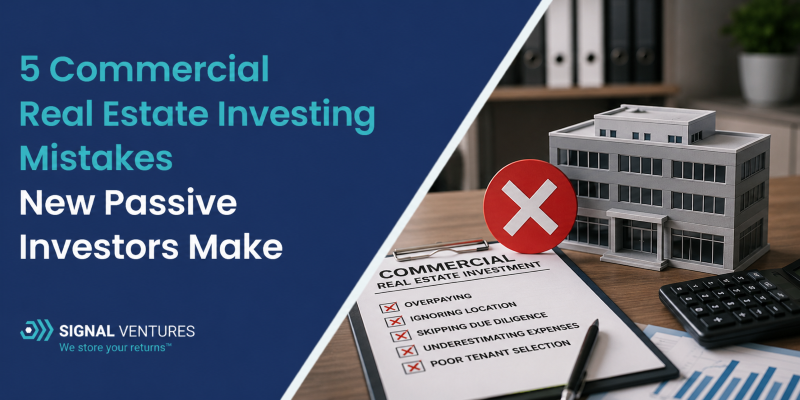
Commercial real estate investing continues to attract new capital, especially from busy professionals and accredited investors looking for passive income, portfolio diversification, and inflation-resistant assets. But while interest in the space is growing, so is the need for better decision-making. In CBRE’s U.S. Investor Intentions Survey, 70% of commercial real estate investors said they planned to buy more assets in 2025 than they did the year before, even as elevated and volatile long-term interest rates remained the top challenge. That means opportunity is still there, but discipline matters more than ever.
If you are new to passive investing, the biggest mistakes usually are not dramatic. They are quiet mistakes: trusting projections too quickly, overlooking risk, and choosing deals that do not fit your goals. Here are five of the most common errors new passive investors make in commercial real estate investing and how to avoid them.
1. Focusing on projected returns instead of sponsor quality
Many new passive investors are drawn to the headline numbers first: IRR, equity multiple, preferred return, and cash-on-cash projections. But in commercial real estate investing, the operator often matters more than the spreadsheet.
Why? Because business plans only work when the sponsor can execute. Refinancing, lease-up, construction, market timing, reporting, and investor communication all depend on the team behind the deal. In today’s market, that execution risk is even more important. According to the Mortgage Bankers Association, 20% of the $4.8 trillion in outstanding commercial and multifamily mortgages — about $957 billion — matures in 202, creating a more complex environment for refinancing and asset management.
Before investing, review the sponsor’s track record, communication standards, underwriting discipline, and whether they invest alongside their investors. If you are evaluating operators, the About Signal Ventures page is a good example of what transparency should look like.
2. Assuming passive means no due diligence
Passive does not mean careless. It simply means you are not handling tenants, maintenance calls, or day-to-day operations yourself.
Too many first-time passive investors confuse hands-off ownership with hands-off analysis. You should still understand the structure, hold period, assumptions, fees, debt terms, and downside scenarios of every opportunity. You also need to know whether the investment is even appropriate for your investor profile. The SEC notes that many private offerings are limited to accredited investors, generally defined as individuals with net worth above $1 million excluding a primary residence, or income above $200,000 individually or $300,000 with a spouse or partner in each of the prior two years. Source
For investors just getting started, these internal resources can help build a strong foundation before committing capital: The Beginner’s Guide to Passive Real Estate Investing and Passive Income Real Estate Investments: 8 Ways to Invest Without Managing Tenants.
3. Investing in an asset class they do not understand
One of the biggest commercial real estate investing mistakes is assuming all property types behave the same way. They do not.
Industrial, multifamily, office, retail, and self-storage each respond differently to supply, demand, interest rates, and local market shifts. That is why passive investors need more than a general belief in “real estate.” They need a basic understanding of the specific asset class they are buying into.
For example, NAIOP reported that U.S. industrial net absorption fell to 170.8 million square feet in 2024, down sharply from 294.8 million in 2023 and 752.1 million in 2021. At the same time, the average industrial vacancy rate rose from 5.9% to 6.2%, the highest level since 2015. Those numbers do not mean industrial is a bad sector. They mean investors must understand timing, market selection, and underwriting assumptions instead of chasing broad asset-class narratives. Source
If you want to compare niche sectors more intelligently, see Self-Storage vs Other Real Estate Investments: A Passive Investor’s Guide and Alternative Real Estate Investments.
4. Ignoring liquidity and interest-rate risk
A good investment on paper can still be the wrong fit for your balance sheet.
Private commercial real estate investments are often illiquid by design. Your money may be tied up for several years, and distributions may not begin as quickly as expected. New passive investors often underestimate how important liquidity, exit timing, and interest-rate sensitivity really are.
CBRE reported that 54% of investors expected overall investment activity to recover by the first half of 2025, but it also noted that long-term rates were expected to remain elevated, with the 10-year Treasury staying above 4% throughout 2025. In its H1 2025 Cap Rate Survey, CBRE also found that more than half of respondents expected slightly lower sales volume, while another 16% expected significantly lower volume, reflecting continued uncertainty around rates, policy, and pricing.
That is why it is critical to match the deal structure to your actual goals. If you need liquidity, one structure may fit better than another. If you want to understand those tradeoffs, read How to Invest in Commercial Real Estate in 2026.
5. Looking only at upside and not downside protection
Sophisticated passive investors do not just ask, “What can I make?” They ask, “What protects me if the plan takes longer, rents soften, or financing changes?”
That mindset matters because commercial real estate investing is not linear. According to the MBA, 24% of office property loans, 22% of industrial loans, and 35% of hotel/motel loans are maturing in 2025. That kind of refinancing pressure can create opportunity, but it also increases the importance of conservative leverage, proper reserves, and realistic exit assumptions.
The best passive investors look for sponsors who stress-test assumptions and communicate clearly, not just sponsors who market the highest projected returns. For a closer look at why underwriting discipline matters, read The Power of Data-Driven Decision-Making in Commercial Real Estate Investing.
FAQs
What is commercial real estate investing for passive investors?
Commercial real estate investing for passive investors means investing in income-producing properties without managing the property yourself. A sponsor or professional operator handles the acquisition, execution, and reporting while investors participate in potential cash flow and appreciation.
Why is sponsor quality so important in commercial real estate investing?
Because passive investors are relying on the sponsor to execute the business plan. In a market where $957 billion in commercial mortgage balances mature in 2025, operator experience and disciplined underwriting matter more than ever.
Are all passive investors eligible for private commercial real estate deals?
No. Many private offerings are limited to accredited investors. The SEC says individuals generally qualify with a net worth over $1 million excluding a primary residence, or annual income over $200,000 individually or $300,000 jointly for the prior two years.
Which asset classes are popular with passive investors?
Multifamily and industrial remain leading choices among investors, according to CBRE, while self-storage and other alternative sectors continue to attract attention for their niche fundamentals and operational flexibility.
If you are exploring commercial real estate investing and want a more transparent, data-driven approach, visit Signal Ventures, review opportunities on the Invest With Us page, and explore the FAQ to learn how passive investors can evaluate opportunities with more confidence.