

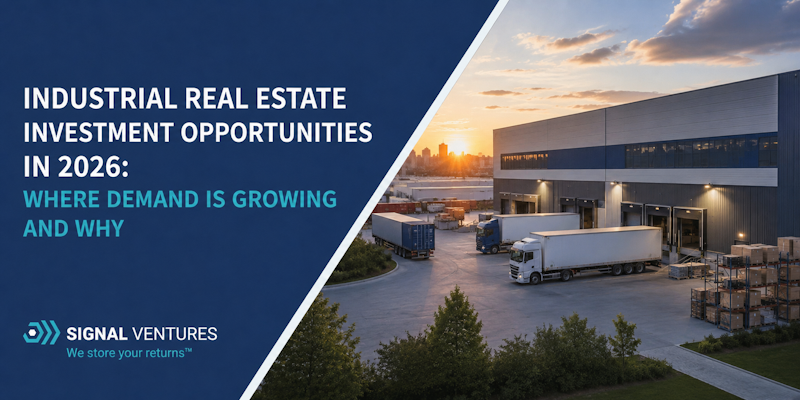
If you want the short answer, the strongest industrial real estate investment opportunities in 2026 are concentrated in markets benefiting from reshoring, e-commerce growth, port connectivity, and manufacturing expansion. That means the Midwest, Southeast, Southwest, and select Pacific Northwest submarkets are attracting the most durable tenant demand, while obsolete products in weaker corridors continue to underperform. CBRE JLL U.S. Census Bureau
For investors, 2026 is not a year to buy industrial space simply because it is industrial. It is a year to be more precise. National leasing activity has improved, but demand is flowing to modern, well-located buildings with access to labor, power, rail, highways, and end consumers. That distinction matters because older inventory is losing relevance even as newer logistics and manufacturing space gains pricing power. CBRE CBRE Q1 2026 U.S. Figures
2026 Industrial Demand Snapshot
Market | Latest Signal | Why It Matters | Source |
U.S. | Q1 2026 industrial leasing reached 249.8M sq. ft., vacancy was 6.7% | Demand is improving as new supply slows | |
U.S. | Q1 2026 e-commerce sales hit $326.7B, or 16.9% of total retail sales | Online retail keeps supporting warehouse and fulfillment demand | |
Portland | 2.2M sq. ft. leased in Q1 2026, with 3.0M sq. ft. of active tenant requirements | Pacific Northwest demand remains active in established corridors | |
Phoenix | 4.9M sq. ft. of net absorption in Q1 2026, vacancy down to 10.2% | Supply is being absorbed as occupiers re-enter the market | |
Columbus | 4.4M sq. ft. of net absorption in Q1 2026, vacancy fell to 5.0% | Manufacturing and logistics demand is strengthening quickly | |
Savannah | 5.7M TEUs handled in 2025, plus record rail container volume | Port-led logistics still drives industrial demand in the Southeast |
Why industrial demand is still growing in 2026
The most important national trend is that industrial demand did not disappear after the post-pandemic construction wave. It matured. NAIOP forecasts 345.9 million square feet of industrial net absorption in 2026 and 267.7 million square feet in 2027, while CBRE expects leasing activity to rise about 5% year over year to nearly 1 billion square feet. At the same time, JLL reports that big-box leasing surged more than 80% year over year in Q1 2026, a sign that major occupiers are still making long-term commitments.
The second trend is manufacturing-led demand. U.S. manufacturing construction spending reached an annualized $190.1 billion in March 2026, according to FRED, and the U.S. Treasury has noted that real manufacturing construction has doubled since the end of 2021. That matters because advanced manufacturing creates follow-on demand for supplier space, flex industrial, logistics buildings, and build-to-suit facilities near new production hubs.
The third trend is e-commerce. The latest U.S. Census Bureau report shows first-quarter 2026 e-commerce sales rose 9.8% year over year and represented 16.9% of total retail sales. That is why modern distribution space, especially in infill and regional fulfillment corridors, still commands attention even after several quarters of normalization.
Where demand is growing most
Columbus and the broader Midwest
The Midwest is one of the clearest 2026 winners because it combines central distribution geography with lower occupancy costs, strong transport connectivity, and growing manufacturing investment. In Columbus, Q1 2026 net absorption reached 4.4 million square feet and vacancy fell to 5.0%, while asking rents rose 12.4% year over year. CBRE and JLL also point to Midwest markets such as Chicago, Detroit, Kansas City, Louisville, and Cincinnati as attractive locations for manufacturing expansion because labor, logistics, and power access remain favorable.
Savannah and the Southeast logistics corridor
The Southeast remains compelling because it offers population growth, business-friendly conditions, and port-linked distribution networks. The Port of Savannah handled nearly 5.7 million TEUs in 2025, with record rail container volume and a multibillion-dollar infrastructure plan underway. Georgia Ports Authority Meanwhile, CBRE expects the Southeast to benefit from domestic manufacturing expansion, and JLL identifies Georgia as one of the top states in announced manufacturing square footage. For investors, this supports demand not only for big-box distribution but also for supplier and light industrial space along inland logistics nodes.
Phoenix and the Southwest manufacturing belt
Phoenix stands out because it is moving from oversupply toward rebalancing. Q1 2026 net absorption hit 4.9 million square feet, deliveries dropped to their lowest level since 2019, and vacancy edged down to 10.2%. CBRE That is important because Arizona is also one of the top states for announced manufacturing growth, according to JLL. In practical terms, Phoenix is becoming more selective, which is exactly when disciplined investors start finding better entry points.
Oregon & Select Pacific Northwest Markets
These markets something more durable: constrained land, local demand, and limited institutional competition.
Bend remains tight. With only 158,864 SF available across a ~4.8M SF market, vacancy sits at 3.32% (Q4 2025). Absorption is positive and new supply is limited. (Compass Commercial, Q4 2025)
Eugene / Springfield tells a land supply story. Eugene’s Clear Industrial Area holds ~650 acres across 11 sites, but site readiness and infrastructure extension determine what actually gets built (City of Eugene Strategy). Springfield’s employment land analysis found just one site of 20+ acres within its UGB, underscoring how scarce larger-format industrial sites are.
Newport is a different thesis entirely, industrial, not warehouse logistics. The Port of Newport is the largest fisheries homeport on the Oregon coast and operates a 17-acre deep-draft International Terminal serving commercial fishing, marine research, and cargo. (Port of Newport Strategic Plan, Newport International Terminal)
The opportunity: Well-underwritten industrial and flex product targeting regional distribution, service tenants, and small-bay users — in markets where supply constraints are structural, not cyclical.
What investors should buy, and what they should avoid
The strongest opportunities in 2026 are modern industrial assets aligned with actual tenant behavior: infill logistics, flex industrial, manufacturing-adjacent buildings, and build-to-suit projects in markets with labor, power, and transport advantages. CBRE specifically notes that first-generation large-box space is attracting tenants, while JLL shows renewed confidence in big-box commitments.
What should investors avoid? Obsolete inventory without clear repositioning potential. CBRE reports more than 100 million square feet of negative absorption in pre-2020 buildings last year. In other words, industrial is still a strong asset class, but building quality and location now matter more than ever.
What this means for passive investors in 2026
For passive investors, 2026 is a market that rewards sponsor discipline. The right industrial investment is increasingly a local story hidden inside a national trend. Markets with resilient logistics networks, manufacturing momentum, and limited relevant supply should continue to outperform, while undifferentiated assets may lag even if the broader sector improves. That is why we believe industrial investing in 2026 should start with demand mapping, tenant relevance, and conservative underwriting, not broad sector enthusiasm. CBRE
FAQs
Is industrial real estate a good investment in 2026?
Yes, but only in the right markets and property types. National data shows leasing has improved and supply pressure is easing, yet tenant demand is increasingly concentrated in modern buildings tied to e-commerce, manufacturing, and regional distribution.
Which industrial markets are growing fastest in 2026?
Some of the strongest signals are showing up in Columbus, Phoenix, Savannah, and several Midwest and Southeast corridors. These markets are benefiting from reshoring, advanced manufacturing, logistics infrastructure, and stronger tenant demand for modern space.
What is driving industrial real estate demand in 2026?
The biggest drivers are e-commerce growth, reshoring, domestic manufacturing expansion, supply chain resilience, and demand for newer, more efficient buildings. Power availability, labor access, and port or rail connectivity are becoming major site-selection filters.
Are industrial flex properties attractive in 2026?
Yes, especially in supply-constrained regional markets. Flex industrial can benefit from manufacturing suppliers, smaller-bay users, and local distribution demand, particularly where land constraints limit new comparable products.
What should accredited investors look for in a passive industrial real estate deal?
Investors should focus on sponsor alignment, conservative underwriting, market-specific demand, realistic lease-up assumptions, and a clear business plan for the asset type. In 2026, local market selection and execution quality are often more important than broad asset-class labels.
If you are evaluating passive exposure to industrial or flex real estate in 2026, we invite you to explore how Signal Ventures approaches data-driven underwriting in Oregon and the Pacific Northwest. To learn how we evaluate risk, structure deals, and align with investors, visit our FAQs or connect with our team.