Bend’s Housing Market Is Returning to Its Long-Run Trend

Bend home prices climbed 119% in a decade. Fresh 2026 supply, pricing, and days-on-market data show the market settling into a balanced, sustainable pace.


Bend home prices climbed 119% in a decade. Fresh 2026 supply, pricing, and days-on-market data show the market settling into a balanced, sustainable pace.

Preferred returns, waterfalls, and IRR vs. equity multiple explained plainly — how private real estate returns actually work, with an investor Q&A.

Evaluating real estate syndication sponsors requires looking beyond polished pitch decks to verify historical performance, fee structures, and skin in the game.
Passive commercial real estate investing can be powerful. It offers access to income-producing assets, professional management
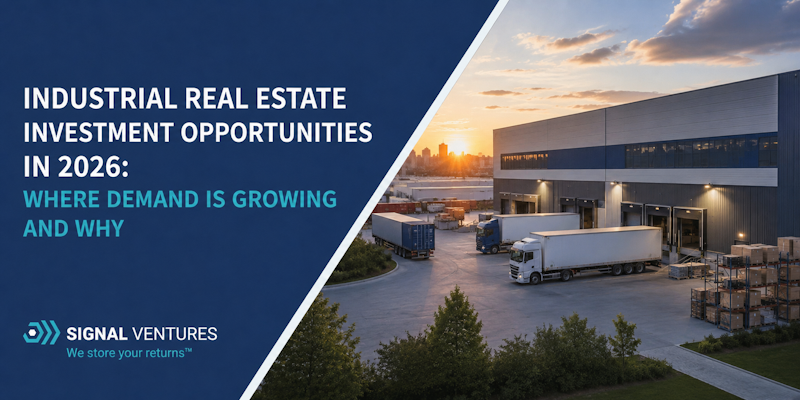
If you want the short answer, the strongest industrial real estate investment opportunities in 2026 are concentrated in markets benefiting from reshoring, e-commerce growth, port connectivity, and manufacturing expansion. That means the Midwest, Southeast, Southwest, and select Pacific Northwest submarkets are attracting the most durable tenant demand, while obsolete products in weaker corridors continue to underperform. CBRE JLL U.S. Census Bureau For investors, 2026 is not a year to buy industrial space simply because it is industrial. It is a year to be more precise. National leasing activity has improved, but demand is flowing to modern, well-located buildings with access to labor, power, rail, highways, and end consumers. That distinction matters because older inventory is losing relevance even as newer logistics and manufacturing space gains pricing power. CBRE CBRE Q1 2026 U.S. Figures 2026 Industrial Demand Snapshot Market Latest Signal Why It Matters Source U.S. Q1 2026 industrial leasing reached 249.8M sq. ft., vacancy was 6.7% Demand is improving as new supply slows CBRE U.S. Q1 2026 e-commerce sales hit $326.7B, or 16.9% of total retail sales Online retail keeps supporting warehouse and fulfillment demand U.S. Census Bureau Portland 2.2M sq. ft. leased in Q1 2026, with 3.0M sq. ft. of active tenant requirements Pacific Northwest demand remains active in established corridors CBRE Phoenix 4.9M sq. ft. of net absorption in Q1 2026, vacancy down to 10.2% Supply is being absorbed as occupiers re-enter the market CBRE Columbus 4.4M sq. ft. of net absorption in Q1 2026, vacancy fell to 5.0% Manufacturing and logistics demand is strengthening quickly CBRE Savannah 5.7M TEUs handled in 2025, plus record rail container volume Port-led logistics still drives industrial demand in the Southeast Georgia Ports Authority Why industrial demand is still growing in 2026 The most important national trend is that industrial demand did not disappear after the post-pandemic construction wave. It matured. NAIOP forecasts 345.9 million square feet of industrial net absorption in 2026 and 267.7 million square feet in 2027, while CBRE expects leasing activity to rise about 5% year over year to nearly 1 billion square feet. At the same time, JLL reports that big-box leasing surged more than 80% year over year in Q1 2026, a sign that major occupiers are still making long-term commitments. The second trend is manufacturing-led demand. U.S. manufacturing construction spending reached an annualized $190.1 billion in March 2026, according to FRED, and the U.S. Treasury has noted that real manufacturing construction has doubled since the end of 2021. That matters because advanced manufacturing creates follow-on demand for supplier space, flex industrial, logistics buildings, and build-to-suit facilities near new production hubs. The third trend is e-commerce. The latest U.S. Census Bureau report shows first-quarter 2026 e-commerce sales rose 9.8% year over year and represented 16.9% of total retail sales. That is why modern distribution space, especially in infill and regional fulfillment corridors, still commands attention even after several quarters of normalization. Where demand is growing most Columbus and the broader Midwest The Midwest is one of the clearest 2026 winners because it combines central distribution geography with lower occupancy costs, strong transport connectivity, and growing manufacturing investment. In Columbus, Q1 2026 net absorption reached 4.4 million square feet and vacancy fell to 5.0%, while asking rents rose 12.4% year over year. CBRE and JLL also point to Midwest markets such as Chicago, Detroit, Kansas City, Louisville, and Cincinnati as attractive locations for manufacturing expansion because labor, logistics, and power access remain favorable. Savannah and the Southeast logistics corridor The Southeast remains compelling because it offers population growth, business-friendly conditions, and port-linked distribution networks. The Port of Savannah handled nearly 5.7 million TEUs in 2025, with record rail container volume and a multibillion-dollar infrastructure plan underway. Georgia Ports Authority Meanwhile, CBRE expects the Southeast to benefit from domestic manufacturing expansion, and JLL identifies Georgia as one of the top states in announced manufacturing square footage. For investors, this supports demand not only for big-box distribution but also for supplier and light industrial space along inland logistics nodes. Phoenix and the Southwest manufacturing belt Phoenix stands out because it is moving from oversupply toward rebalancing. Q1 2026 net absorption hit 4.9 million square feet, deliveries dropped to their lowest level since 2019, and vacancy edged down to 10.2%. CBRE That is important because Arizona is also one of the top states for announced manufacturing growth, according to JLL. In practical terms, Phoenix is becoming more selective, which is exactly when disciplined investors start finding better entry points. Oregon & Select Pacific Northwest Markets These markets something more durable: constrained land, local demand, and limited institutional competition. Bend remains tight. With only 158,864 SF available across a ~4.8M SF market, vacancy sits at 3.32% (Q4 2025). Absorption is positive and new supply is limited. (Compass Commercial, Q4 2025) Eugene / Springfield tells a land supply story. Eugene’s Clear Industrial Area holds ~650 acres across 11 sites, but site readiness and infrastructure extension determine what actually gets built (City of Eugene Strategy). Springfield’s employment land analysis found just one site of 20+ acres within its UGB, underscoring how scarce larger-format industrial sites are. Newport is a different thesis entirely, industrial, not warehouse logistics. The Port of Newport is the largest fisheries homeport on the Oregon coast and operates a 17-acre deep-draft International Terminal serving commercial fishing, marine research, and cargo. (Port of Newport Strategic Plan, Newport International Terminal) The opportunity: Well-underwritten industrial and flex product targeting regional distribution, service tenants, and small-bay users — in markets where supply constraints are structural, not cyclical. What investors should buy, and what they should avoid The strongest opportunities in 2026 are modern industrial assets aligned with actual tenant behavior: infill logistics, flex industrial, manufacturing-adjacent buildings, and build-to-suit projects in markets with labor, power, and transport advantages. CBRE specifically notes that first-generation large-box space is attracting tenants, while JLL shows renewed confidence in big-box commitments. What should investors avoid? Obsolete inventory without clear repositioning potential. CBRE reports more than 100 million square feet … Read more
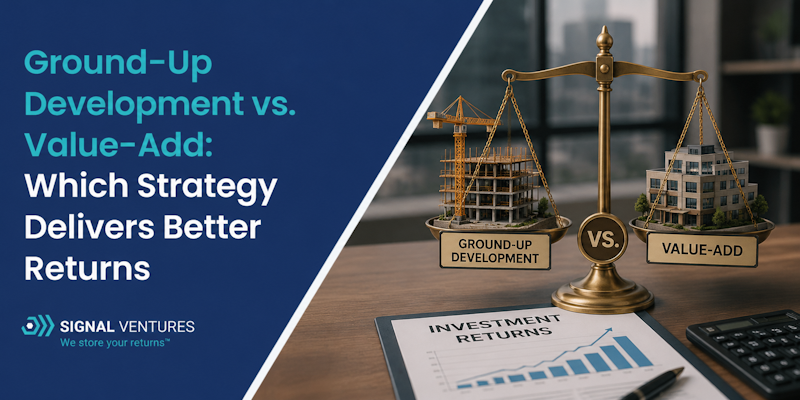
For passive investors, the real question is not which strategy sounds more exciting. It is the one that fits today’s market, your risk tolerance, and your return goals. In 2026, that decision matters more than ever because construction costs remain elevated, financing is selective, and disciplined operators are finding opportunity in both new development and reset pricing. At Signal Ventures, the model is clearly built for investors who value data-driven underwriting, full-cycle execution, and targeted opportunities in Oregon and the Pacific Northwest. That matters because the best answer is rarely universal. It is market-specific and operator-specific. What is the difference between ground-up development and value-add? Ground-up development means building a new asset from the ground up, from land, entitlements, construction, lease-up, and exit. Value-add real estate means buying an existing asset and improving operations, occupancy, physical condition, or revenue to increase value. For passive investors, the tradeoff is simple: Strategy Main Advantage Main Risk Best Fit Ground-up development Higher upside, modern product, less inherited deferred maintenance Entitlement, construction, lease-up, and timing risk Investors seeking growth over immediate income Value-add real estate Faster path to cash flow, lower development risk, can buy at reset pricing Hidden capex, operational complexity, execution risk Investors seeking earlier income and risk-adjusted upside 2025-2026 market snapshot: what the data says Here is why the timing of this debate matters now: Market Signal Latest Data Why It Matters U.S. commercial real estate investment volume CBRE expected 10% growth to $437 billion in 2025 Transaction activity is recovering, which can favor value-add acquisitions at repriced bases Multifamily starts NAHB said starts fell 25% in 2024 to 355,000, are expected to fall 11% in 2025 to 317,000, then rise 6% in 2026 to 336,000 Fewer new starts can improve the future supply-demand balance for successful development projects Units under construction NAHB noted that about 1 million apartments were under construction, the highest since 1973 Near-term lease-up can be competitive in some submarkets Latest U.S. housing starts U.S. Census Bureau reported 1.502 million SAAR in March 2026 Development is still active, but not easy, which rewards strong underwriting Latest building permits U.S. Census Bureau reported 1.372 million SAAR in March 2026, down 7.4% year over year Slower permitting suggests future supply may stay more contained 2026 multifamily loan caps FHFA set caps at $88 billion each for Fannie Mae and Freddie Mac, $176 billion combined Liquidity remains available, especially for qualifying multifamily financing Which strategy delivers better returns for passive investors? In today’s market, value-add often wins on risk-adjusted returns CBRE says returns this cycle are likely to be income driven, with underwriting and asset management doing the heavy lifting. That is a big clue. For passive investors who want distributions sooner and more visibility into current operations, value-add real estate often has the edge in 2025 and early 2026. Why? Because you can buy an existing income-producing asset, improve it, and potentially benefit from reset pricing without taking full land, entitlement, and construction risk. But ground-up development can still produce the best absolute upside Ground-up development can outperform when three things line up: strong local demand, limited new supply, and an operator with real development discipline. That is especially true in niche sectors and constrained regional markets. This is where Signal Ventures’ positioning becomes relevant. The firm focuses on self-storage, industrial/flex, and select residential projects in Oregon and the Pacific Northwest, with an emphasis on analytics, third-party feasibility work, and full-cycle control. Signal Venture typically targets 25% to 40% IRRs for accredited investors, with a 3 to 7 year hold period. In other words, for passive investors who can tolerate delayed cash flow in exchange for potentially higher upside, ground-up development may deliver better absolute returns, but only when the sponsor can control costs, timing, and lease-up risk. The smarter takeaway for passive investors If your priority is earlier cash flow, clearer operating visibility, and risk-adjusted performance, value-add is usually the stronger play right now. If your priority is maximum upside, newer product, and long-term value creation, ground-up development may deliver better total returns, especially in supply-constrained markets with experienced operators. Simple rule of thumb Choose value-add if you want income sooner and less development complexity Choose ground-up development if you want higher upside and trust the sponsor’s execution Choose the operator first, then the strategy That last point matters most. A mediocre value-add deal can underperform a great development deal, and vice versa. FAQs Is ground-up development riskier than value-add? Yes. Ground-up development includes land, permitting, construction, cost overruns, and lease-up risk. Value-add usually removes some of those variables because the asset already exists. Which strategy is better for passive income? Value-add is generally better for passive income because existing assets may produce cash flow sooner, while ground-up projects often delay distributions until stabilization. Can ground-up development deliver higher IRRs? Yes. Strong ground-up projects can produce higher projected IRRs, especially in undersupplied markets. But higher return targets come with higher execution risk. What should accredited investors look for in 2026? Focus on conservative underwriting, local supply-demand data, sponsor co-investment, contingency planning, and market-specific feasibility studies. Why does location matter so much? Returns are highly local. We emphasize on Oregon and Pacific Northwest markets with job growth, barriers to entry, and limited supply, which can support both lease-up and exit value. If you are an accredited investor comparing ground-up development vs value-add and want a sponsor that combines analytics, transparency, and hands-on execution, explore Signal Ventures and join the investor network to review data-driven opportunities built for passive investors.
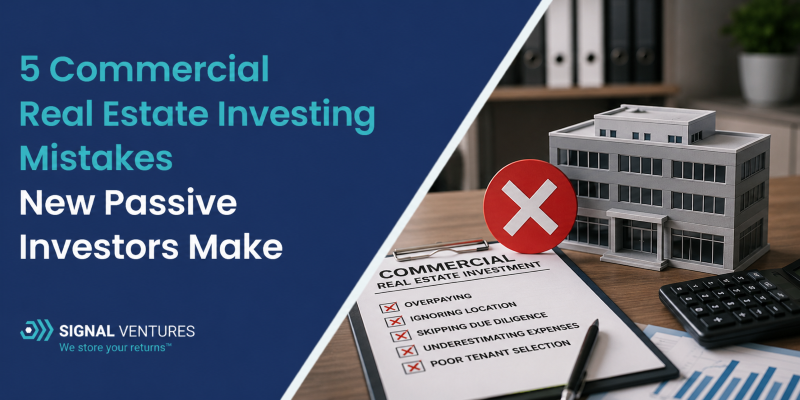
Commercial real estate investing continues to attract new capital, especially from busy professionals and accredited investors looking for passive income, portfolio diversification, and inflation-resistant assets. But while interest in the space is growing, so is the need for better decision-making. In CBRE’s U.S. Investor Intentions Survey, 70% of commercial real estate investors said they planned to buy more assets in 2025 than they did the year before, even as elevated and volatile long-term interest rates remained the top challenge. That means opportunity is still there, but discipline matters more than ever. If you are new to passive investing, the biggest mistakes usually are not dramatic. They are quiet mistakes: trusting projections too quickly, overlooking risk, and choosing deals that do not fit your goals. Here are five of the most common errors new passive investors make in commercial real estate investing and how to avoid them. 1. Focusing on projected returns instead of sponsor quality Many new passive investors are drawn to the headline numbers first: IRR, equity multiple, preferred return, and cash-on-cash projections. But in commercial real estate investing, the operator often matters more than the spreadsheet. Why? Because business plans only work when the sponsor can execute. Refinancing, lease-up, construction, market timing, reporting, and investor communication all depend on the team behind the deal. In today’s market, that execution risk is even more important. According to the Mortgage Bankers Association, 20% of the $4.8 trillion in outstanding commercial and multifamily mortgages — about $957 billion — matures in 202, creating a more complex environment for refinancing and asset management. Before investing, review the sponsor’s track record, communication standards, underwriting discipline, and whether they invest alongside their investors. If you are evaluating operators, the About Signal Ventures page is a good example of what transparency should look like. 2. Assuming passive means no due diligence Passive does not mean careless. It simply means you are not handling tenants, maintenance calls, or day-to-day operations yourself. Too many first-time passive investors confuse hands-off ownership with hands-off analysis. You should still understand the structure, hold period, assumptions, fees, debt terms, and downside scenarios of every opportunity. You also need to know whether the investment is even appropriate for your investor profile. The SEC notes that many private offerings are limited to accredited investors, generally defined as individuals with net worth above $1 million excluding a primary residence, or income above $200,000 individually or $300,000 with a spouse or partner in each of the prior two years. Source For investors just getting started, these internal resources can help build a strong foundation before committing capital: The Beginner’s Guide to Passive Real Estate Investing and Passive Income Real Estate Investments: 8 Ways to Invest Without Managing Tenants. 3. Investing in an asset class they do not understand One of the biggest commercial real estate investing mistakes is assuming all property types behave the same way. They do not. Industrial, multifamily, office, retail, and self-storage each respond differently to supply, demand, interest rates, and local market shifts. That is why passive investors need more than a general belief in “real estate.” They need a basic understanding of the specific asset class they are buying into. For example, NAIOP reported that U.S. industrial net absorption fell to 170.8 million square feet in 2024, down sharply from 294.8 million in 2023 and 752.1 million in 2021. At the same time, the average industrial vacancy rate rose from 5.9% to 6.2%, the highest level since 2015. Those numbers do not mean industrial is a bad sector. They mean investors must understand timing, market selection, and underwriting assumptions instead of chasing broad asset-class narratives. Source If you want to compare niche sectors more intelligently, see Self-Storage vs Other Real Estate Investments: A Passive Investor’s Guide and Alternative Real Estate Investments. 4. Ignoring liquidity and interest-rate risk A good investment on paper can still be the wrong fit for your balance sheet. Private commercial real estate investments are often illiquid by design. Your money may be tied up for several years, and distributions may not begin as quickly as expected. New passive investors often underestimate how important liquidity, exit timing, and interest-rate sensitivity really are. CBRE reported that 54% of investors expected overall investment activity to recover by the first half of 2025, but it also noted that long-term rates were expected to remain elevated, with the 10-year Treasury staying above 4% throughout 2025. In its H1 2025 Cap Rate Survey, CBRE also found that more than half of respondents expected slightly lower sales volume, while another 16% expected significantly lower volume, reflecting continued uncertainty around rates, policy, and pricing. That is why it is critical to match the deal structure to your actual goals. If you need liquidity, one structure may fit better than another. If you want to understand those tradeoffs, read How to Invest in Commercial Real Estate in 2026. 5. Looking only at upside and not downside protection Sophisticated passive investors do not just ask, “What can I make?” They ask, “What protects me if the plan takes longer, rents soften, or financing changes?” That mindset matters because commercial real estate investing is not linear. According to the MBA, 24% of office property loans, 22% of industrial loans, and 35% of hotel/motel loans are maturing in 2025. That kind of refinancing pressure can create opportunity, but it also increases the importance of conservative leverage, proper reserves, and realistic exit assumptions. The best passive investors look for sponsors who stress-test assumptions and communicate clearly, not just sponsors who market the highest projected returns. For a closer look at why underwriting discipline matters, read The Power of Data-Driven Decision-Making in Commercial Real Estate Investing. FAQs What is commercial real estate investing for passive investors? Commercial real estate investing for passive investors means investing in income-producing properties without managing the property yourself. A sponsor or professional operator handles the acquisition, execution, and reporting while investors participate in potential cash flow and appreciation. Why is sponsor quality so important … Read more